Contact us
Send Us Your Case Details
We’ll respond and let you know the best way to proceed with your case.
For the initial six weeks of the pandemic last year, I was not allowed to work. I had not had six weeks off from work since I left home at 17 for my first full time job, at a summer camp. While I didn’t work full time during school, I always had one, sometimes two and often three part-time jobs, including short-order cook, resident adviser, building director, lifeguard, and book-store clerk. As a law student, I worked during the summers, and for 42 years thereafter, I have worked, with never more than 2 weeks off or between jobs. So six weeks was a shock to my system.
And this was a difficult six weeks, with the first of the staggering “stay at home,” orders. Really? Even if you did go out, there was nothing left to do. One by one, the gyms, the parks, the tracks, all closed. Everyone looked at you with fear, like you were one of those on the “Walking Dead.”
Like most people, I watched a lot of Netflix shows that I thought I would like, but really didn’t. Then I noticed there were a lot of things streaming on various services that I knew I wouldn’t like, but I watched them anyway.
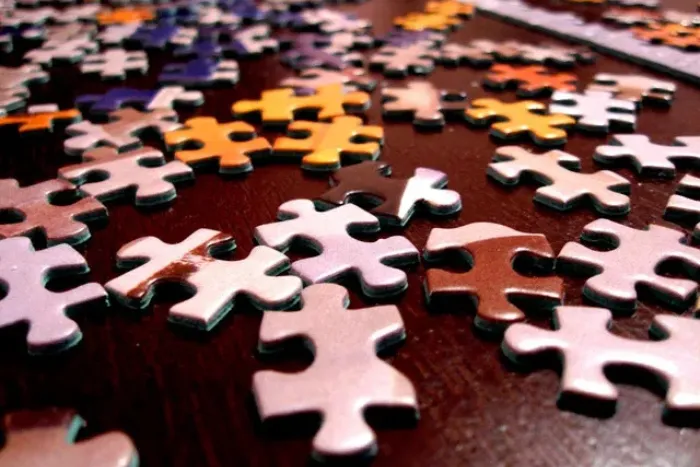
Three weeks in, my wife got out a crossword puzzle she had been meaning to do for years. It was a hard one, depicting a pack of zebras, each with stripes of several similar shades of black and brown balancing against the several similar shades of dirty white stripes. The zebras were drinking from a murky pond that reflected their similar, murkier images. The pieces were tiny, and they all looked pretty much the same. My wife did a little, then left it on the table. It stayed there for a while, tempting my severely offended sense of order in the universe.
One night I could watch no more Netflix and I sat down to see if I could move the project forward. I didn’t get up for three hours. I had only placed about 20 pieces, but I was hooked. For the next few days, the zebra puzzle was the first thing I did in the morning and the last thing I did at night. I found myself walking by, and being drawn in, then losing track of time. I was not going to let those zebras beat me. So much of the world seemed to be falling apart. Here was my chance to put things back together, to bring order to a meaningless jumble of black and white.
When I was finally done, my wife found that she liked the effect of the project on me. She found another puzzle in another closet. Then she borrowed some puzzles from our neighbors, who had a large collection. Then she started buying puzzles online, challenging me with maps of the world, complex multicolored jungle scenes, tiny pictures of helicopters set against gently shaded backgrounds. I would not give up. I found a way to pile the finished puzzles on top of each other so that there was room to do the next one, and because I couldn’t bear to mess them up and put them back in the box.
Even piling puzzles on top of each other, it became difficult to fit them all on our dining room table. Finally, my brother and his son came by, and we gave my nephew the fun job of breaking up all the puzzles and getting them back into boxes. It was hard for me, but in a few days I could return to work, and to the illusion that the work I did each day was helping to put the world back in order.
I wondered: Did I learn something from this exercise, or had this time been wasted as much as the time I spent watching Tiger King?
So I sat down and tried to write out a few of the lessons learned.
There are more things I learned, of course. Stay away from puzzles of zebras, for example.
I was happy to return to work. It takes the energy out of me so that I don’t need to do jigsaw puzzles to keep from going stir crazy.
I’m glad for the lessons I learned from jigsaw puzzles. Wish I could say I was glad I watched all those shows on Netflix. But I really can’t.
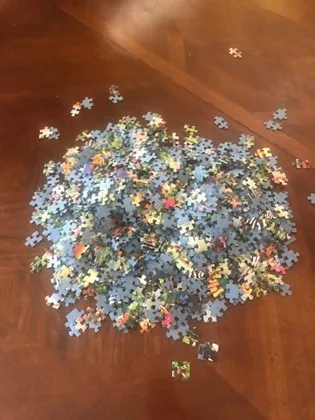
Chaos
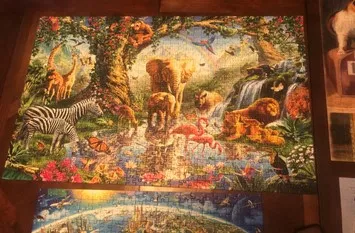
Order